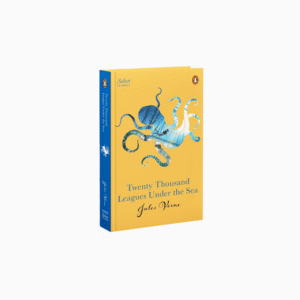
‘The sea is everything…Its breath is pure and healthy. It is an immense desert, where man is never lonely, for he feels life stirring on all sides.’
Fascinated with the wonders of the sea, Professor Pierre Aronnax, a marine biologist, along with his loyal servant Conseil and the harpooner Ned Land, embarks on an expedition to search for a sea monster.
Their missions lead them to discover a technologically advanced submarine called the Nautilus, commanded by the enigmatic Captain Nemo.
The further Professor Pierre travels into the depths of the sea, his inner conflicts surface to life, as he releases ultimately his soul was seeking refuge from a world, he believed had wronged him.
The mesmerizing underwater world with exotic marine life and breathtaking landscapes is the perfect getaway for both Professor Pierre and the reader. The silence and calm invoke reflection into what is one’s purpose in life; and how must nature and humans share the planet. A thoughtful and cathartic read for all ages.
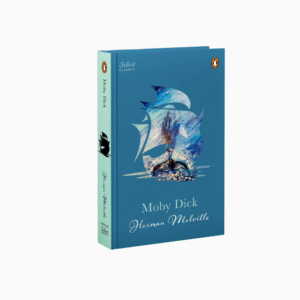
On a previous voyage, a mysterious white whale had ripped off the leg of a sea captain named Ahab. Now the crew of the Pequod, on a pursuit that features constant adventure and horrendous mishaps, must follow the mad Ahab into the abyss to satisfy his unslakeable thirst for vengeance. Narrated by the cunningly observant crew member Ishmael, Moby-Dick is the tale of the hunt for the elusive, omnipotent, and ultimately mystifying white whale—Moby Dick. On its surface, Moby-Dick is a vivid documentary of life aboard a nineteenth-century whaler, a virtual encyclopedia of whales and whaling, replete with facts, legends, and trivia that Melville had gleaned from personal experience and scores of sources. But as the quest for the whale becomes increasingly perilous, the tale works on allegorical levels, likening the whale to human greed, moral consequence, good, evil, and life itself. Who is good? The great white whale who, like Nature, asks nothing but to be left in peace? Or the bold Ahab who, like scientists, explorers, and philosophers, fearlessly probes the mysteries of the universe? Who is evil? The ferocious, man-killing sea monster? Or the revenge-obsessed madman who ignores his own better nature in his quest to kill the beast? Scorned by critics upon its publication, Moby-Dick was publicly derided during its author’s lifetime. Yet Melville’s masterpiece has outlived its initial misunderstanding to become an American classic of unquestionably epic proportions.
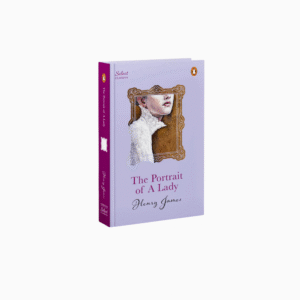
Set in 19th century, Isabel Archer is a spirited, intelligent and independent young American woman who inherits a fortune and embarks on a journey to Europe.
She always believed she’d live life on her own terms and ‘affront her destiny.’ However, during her travel, she realizes that an enduring relationship and a woman’s sense of self don’t go hand in hand. She had various encounters with suitors and manipulative individuals, including the enigmatic and cunning Gilbert Osmond, which challenged her idealistic notions. Isabel though stood fast on her believes and always chose herself first.
Through Isabel’s story we are compelled to wonder, should love to be this complicated? And more importantly, why are women, who are layered and complexed individuals, reduced to such singular roles?
The Portrait of a Lady is a deeply moving, romantic and sensitive story reflecting complex human emotions which will resonate with all readers alike
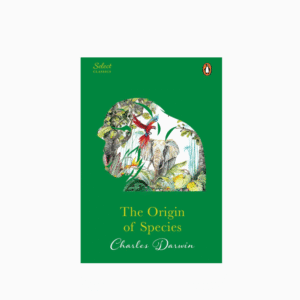
“It is not the strongest of the species that survives, nor the most intelligent that survives. It is the one most responsive to change.”For the longest period, society believed that all beings were created at once over a short span of time. Up until Charles Darwin introduced the theory of evolution and argued that living beings as they function today have developed through the process of natural selection, challenging conventional beliefs about the origins of life.This theory is driven by the differential survival and reproduction of individuals with advantageous traits. The offsprings which acquire stronger traits through genetics, will have a higher chance of adapting to the changing environment.Darwin’s theory suggests that all species, including humans, share a common ancestry, providing a unifying framework for the diversity of life on Earth.An absolutely engaging and enlightening read to understand the human body and be more in sync with how we can utilize our physical abilities to adapt to the world’s changing requirements.
Afin de vous offrir une expérience d’achat personnalisée, notre site utilise des cookies. En continuant à naviguer sur ce site, vous acceptez notre utilisation des cookies.







 Nous contacter sur WhatsApp